Agentic AI Frameworks Compared: Best Options for 2026
Compare the top agentic AI frameworks — LangGraph, CrewAI, AutoGen, and more. Benchmarks, code examples, and use-case recommendations.
Agentic AI frameworks are the hottest category in the AI tooling space right now — and also the most confusing. With over a dozen options competing for attention, picking the right one for your project can feel like a full-time job. According to McKinsey, only 23% of organizations have successfully scaled agentic AI systems beyond the pilot stage. The rest are stuck experimenting.
The problem is not a lack of frameworks. It is choosing the one that actually fits your use case, scales in production, and does not lock you into a dead-end architecture. This guide compares the leading agentic AI frameworks head-to-head with real benchmarks, code examples, and honest assessments of where each one shines — and where it falls short.
TL;DR — Quick Picks by Use Case
| Use Case | Best Framework | Why |
|---|---|---|
| Complex stateful workflows | LangGraph | Lowest latency, explicit graph-based control flow |
| Multi-agent teams in production | CrewAI | Role-based delegation, layered memory, proven at scale |
| Research and prototyping | AutoGen | Async messaging, flexible agent patterns, Studio UI |
| Lightweight experiments | OpenAI Agents SDK | Minimal overhead, tight OpenAI integration |
| Type-safe production code | Pydantic AI | Python-native validation, clean dependency injection |
| Enterprise RAG pipelines | LlamaIndex | 300+ document types, managed cloud option |
If you want the details behind these picks, keep reading.
What Makes a Framework “Agentic”?
Before comparing specific tools, it helps to understand what separates agentic AI from standard generative AI. A chatbot that answers questions is generative AI. An agent that plans a sequence of actions, uses external tools, adapts based on results, and works toward a goal autonomously — that is agentic AI.
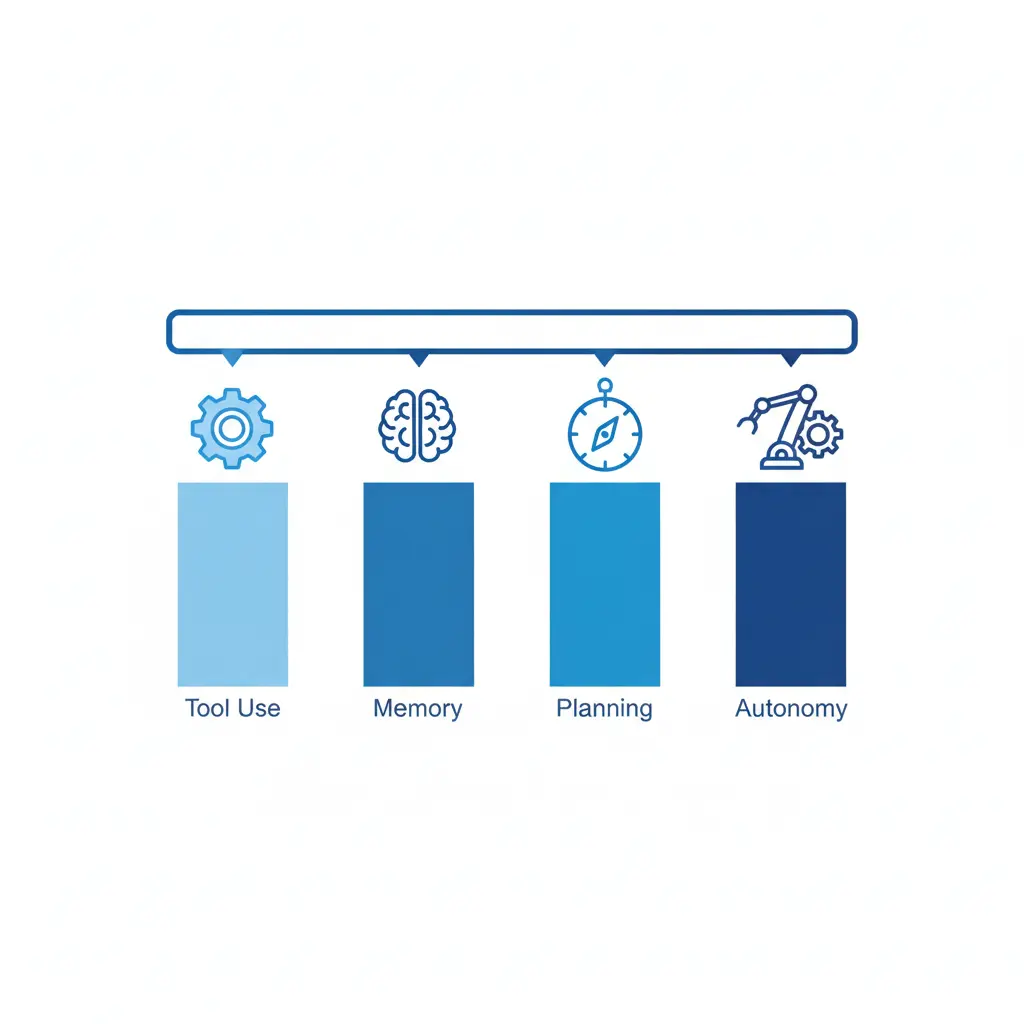
Every agentic framework needs to handle five core capabilities, often called the four pillars of agentic AI plus orchestration:
The Four Pillars
- Planning and Reasoning: The agent breaks a complex goal into smaller steps and decides what to do next based on context
- Tool Use: The agent can call external APIs, query databases, run code, or interact with other services
- Memory: The agent maintains context across interactions — short-term (within a conversation) and long-term (across sessions)
- Autonomy: The agent operates with minimal human intervention, making decisions and recovering from errors independently
Plus: Orchestration
When you have multiple agents working together — a researcher agent feeding data to an analyst agent, supervised by a manager agent — you need orchestration. This is where frameworks diverge most sharply. Some handle it natively (LangGraph, CrewAI), while others require you to build it yourself (LangChain, Pydantic AI).
Head-to-Head Framework Comparison
Let’s dig into the six most production-relevant agentic AI frameworks in 2026. For each, we cover architecture, strengths, weaknesses, and a minimal code example so you can see how they feel in practice.
LangGraph — Best for Complex Workflows
What it is: A graph-based orchestration framework built on top of LangChain. You define agents and their interactions as nodes and edges in a directed graph.
Why it stands out: According to AIMultiple benchmarks, LangGraph delivers the lowest latency and lowest token consumption among the major frameworks for equivalent data analysis tasks. The graph structure gives you explicit visibility into execution flow — you can see exactly which path your agents took and why.
Best for: Stateful multi-step workflows where you need fine-grained control over agent interactions, conditional branching, and human-in-the-loop checkpoints.
from langgraph.graph import StateGraph, START, END

# Define your graph
workflow = StateGraph(AgentState)
workflow.add_node("researcher", research_agent)
workflow.add_node("writer", writing_agent)
workflow.add_node("reviewer", review_agent)

# Define edges (control flow)
workflow.add_edge(START, "researcher")
workflow.add_edge("researcher", "writer")
workflow.add_conditional_edges("reviewer", should_revise,
    {"revise": "writer", "approve": END})

app = workflow.compile()
result = app.invoke({"task": "Write a market analysis report"})Tradeoff: The graph abstraction is powerful but adds complexity. Simple single-agent tasks feel over-engineered in LangGraph. The learning curve is steeper than alternatives like CrewAI.
CrewAI — Best for Multi-Agent Teams
What it is: A framework that models AI agents as team members with defined roles, goals, and backstories. Agents collaborate through task delegation, much like a real team.
Why it stands out: CrewAI has the most mature multi-agent orchestration with built-in support for hierarchical delegation, layered memory (short-term via ChromaDB, long-term via SQLite), and configurable agent hierarchies. It has scaled to millions of active agents in production environments.
Best for: Production systems where multiple specialized agents need to collaborate — content pipelines, research workflows, customer service escalation chains.
from crewai import Agent, Task, Crew

researcher = Agent(
    role="Senior Research Analyst",
    goal="Find comprehensive data on market trends",
    backstory="You are a veteran analyst with 15 years of experience",
    tools=[search_tool, scrape_tool]
)

writer = Agent(
    role="Technical Writer",
    goal="Create clear, engaging reports from research data",
    backstory="You specialize in making complex data accessible"
)

research_task = Task(
    description="Research Q1 2026 AI market trends",
    agent=researcher,
    expected_output="Detailed report with statistics and sources"
)

crew = Crew(agents=[researcher, writer], tasks=[research_task])
result = crew.kickoff()Tradeoff: The “role-playing” abstraction is intuitive but can feel rigid for unconventional agent patterns. Memory configuration has many moving parts.
AutoGen — Best for Research and Prototyping
What it is: Microsoft’s framework for building multi-agent conversation systems. Agents communicate through async message passing, making it natural for debate-style and collaborative reasoning patterns.
Why it stands out: AutoGen’s Studio UI lets you prototype agent systems visually without code. The AgentChat framework provides event-driven orchestration with built-in support for group conversations where agents discuss, critique, and refine each other’s outputs.
Best for: Research projects, complex reasoning tasks that benefit from multi-agent debate, rapid prototyping before committing to a production framework.
from autogen import AssistantAgent, UserProxyAgent

assistant = AssistantAgent(
    name="analyst",
    llm_config={"model": "gpt-4o"}
)

user_proxy = UserProxyAgent(
    name="user",
    human_input_mode="TERMINATE",
    code_execution_config={"work_dir": "output"}
)

user_proxy.initiate_chat(
    assistant,
    message="Analyze the correlation between interest rates and tech stocks in Q1 2026"
)Tradeoff: Lacks built-in state persistence — you need to add your own storage layer for production. The conversation-centric model does not map cleanly to all workflow types.
OpenAI Agents SDK — Best for Lightweight Builds
What it is: OpenAI’s official SDK for building agents (formerly Swarm). Designed to be minimal and opinionated — agent handoffs, tool calls, and guardrails with very little boilerplate.
Best for: Simple agent systems tightly integrated with OpenAI models. Quick experiments, internal tools, and projects where you want to ship fast without learning a complex framework.
from openai import agents

agent = agents.Agent(
    name="support_bot",
    instructions="You help users troubleshoot technical issues",
    tools=[knowledge_base_search, create_ticket]
)

result = agents.run(agent, "My deployment keeps failing with OOM errors")Tradeoff: Stateless by design — no built-in memory or state management. No human-in-the-loop support. Tightly coupled to OpenAI’s API, which limits model flexibility.
Pydantic AI — Best for Type-Safe Production Code
What it is: Built by the creators of Pydantic (the validation library used by FastAPI, LangChain, and most of the Python AI ecosystem). It brings the same philosophy of type safety and validation to agent development.
Best for: Teams that prioritize code quality, testing, and maintainability. Production systems where runtime errors from malformed agent outputs are unacceptable.
from pydantic_ai import Agent

agent = Agent(
    "openai:gpt-4o",
    system_prompt="You are a financial analyst. Return structured data only.",
    result_type=MarketReport  # Pydantic model — output is validated
)

result = agent.run_sync("Summarize NVIDIA's Q4 earnings")
print(result.data.revenue) # Type-safe accessTradeoff: Focused on single-agent patterns. Multi-agent orchestration requires manual implementation. Smaller ecosystem and community compared to LangGraph or CrewAI.
LlamaIndex — Best for Enterprise RAG
What it is: Originally a data framework for connecting LLMs to external data. It has evolved into a full agentic platform with LlamaCloud for managed RAG pipelines and agent orchestration.
Best for: Enterprise applications that need to process large document collections — legal, healthcare, financial services. Supports 300+ document types out of the box.
Tradeoff: The agentic capabilities are newer and less mature than the RAG features. Can feel heavyweight for simple agent tasks.
Full Comparison Table
| Feature | LangGraph | CrewAI | AutoGen | OpenAI SDK | Pydantic AI | LlamaIndex |
|---|---|---|---|---|---|---|
| Multi-agent | Native | Native | Native | Basic handoffs | Manual | Native |
| Memory | Thread-level | Layered (ChromaDB + SQLite) | Manual | None | Manual | Built-in RAG |
| Human-in-the-loop | Yes | Yes | Yes | No | Manual | Yes |
| Latency | Lowest | Low | Medium | Low | Low | Medium |
| Token efficiency | Best | Good | Good | Good | Good | Variable |
| Learning curve | Steep | Moderate | Moderate | Easy | Easy | Moderate |
| Model flexibility | Any LLM | Any LLM | Any LLM | OpenAI only | Any LLM | Any LLM |
| Production readiness | High | High | Medium | Medium | High | High |
Agentic AI vs Generative AI: What Is the Difference?
This distinction matters because it affects which tools you actually need.
Generative AI produces outputs — text, images, code — based on a prompt. It is reactive: you ask, it answers. ChatGPT, Claude, and Midjourney are generative AI. The interaction is typically a single turn or a conversation.
Agentic AI goes further. An agent receives a goal, then autonomously plans, executes multi-step actions, uses tools, and adapts based on intermediate results. It is proactive, not just reactive.
A practical example: generative AI can write a market report if you give it data. Agentic AI can find the data (tool use), analyze trends (reasoning), check its work against a database (memory + tool use), and revise the report based on feedback (planning) — all without you micromanaging each step.
Most frameworks in this guide let you build both generative and agentic applications, but their agentic capabilities — tool orchestration, memory, multi-agent coordination — are what justify their existence. If you only need single-turn generation, you probably don’t need a framework at all.
Who Should Use Each Framework?
Choose LangGraph if you:
- Need precise control over agent execution order and conditional logic
- Are building complex pipelines with branching, loops, and checkpoints
- Have a team experienced with graph-based programming models
Choose CrewAI if you:
- Want the fastest path to a multi-agent production system
- Think naturally in terms of team roles and task delegation
- Need built-in memory that persists across sessions
Choose AutoGen if you:
- Are in the research or prototyping phase
- Want agents that debate and refine each other’s outputs
- Prefer a visual builder (AutoGen Studio) for initial design
Choose OpenAI Agents SDK if you:
- Want minimal setup with OpenAI models
- Are building internal tools or simple automations
- Don’t need multi-agent orchestration or persistent memory
Choose Pydantic AI if you:
- Prioritize type safety and testable code
- Are already using Pydantic/FastAPI in your stack
- Need validated, structured outputs from your agents
Choose LlamaIndex if you:
- Have large document collections to process
- Need enterprise-grade RAG with agent capabilities
- Want a managed cloud option to reduce ops burden
Frequently Asked Questions
What Are the Four Pillars of Agentic AI?
The four pillars are planning (breaking goals into steps), tool use (interacting with external systems), memory (retaining context across interactions), and autonomy (operating independently with minimal human oversight). Every serious agentic framework implements these four capabilities, though the depth and approach vary significantly — CrewAI has the most mature memory system, while LangGraph excels at planning through its graph-based architecture.
What Is the Best Agentic Framework for Production?
It depends on your use case. For complex stateful workflows, LangGraph offers the lowest latency and most explicit control. For multi-agent team collaboration, CrewAI is the most production-proven with built-in memory and delegation. For type-safe, testable code, Pydantic AI brings the rigor of Python’s validation ecosystem. There is no single “best” — the right choice depends on your team’s skills, your architecture needs, and whether you need multi-agent orchestration.
What Is the Difference Between Agentic AI and Generative AI?
Generative AI produces outputs from prompts reactively. Agentic AI autonomously plans, acts, uses tools, and adapts toward a goal. A chatbot answering questions is generative; a system that independently researches a topic, writes a report, checks facts against a database, and revises based on feedback is agentic. Agentic systems typically use generative AI models as their reasoning engine but add planning, memory, and tool-use layers on top.
Is It Worth Building with Agentic AI in 2026?
Yes, but set realistic expectations. McKinsey reports that only 23% of organizations have scaled agentic AI beyond pilots. The technology is powerful but still maturing. Start with a clear, bounded use case — document processing, customer service routing, research automation — rather than trying to build a fully autonomous general-purpose agent. Use frameworks with human-in-the-loop support so you can maintain oversight while the system proves itself.
What Are Some Agentic AI Systems in Production Today?
Common production applications include customer service agents that handle multi-step issue resolution (using CrewAI or LangGraph), research assistants that autonomously gather and synthesize information (AutoGen), code generation pipelines where agents write, review, and test code collaboratively, and document processing systems that extract, validate, and route information from enterprise documents (LlamaIndex). Security operations centers use agentic AI to reduce threat investigation time by up to 80%, according to Exabeam.
The Bottom Line
The agentic AI frameworks landscape in 2026 is rich but fragmented. No single framework wins across every dimension. LangGraph leads on performance, CrewAI leads on multi-agent maturity, and Pydantic AI leads on code quality. The best approach: start with a small prototype using the framework that matches your primary use case, prove it works, then scale. Don’t over-engineer your first agent — the frameworks are evolving fast, and what matters most is shipping something that delivers value today.
Product recommendations are based on independent research and testing. We may earn a commission through affiliate links at no extra cost to you.